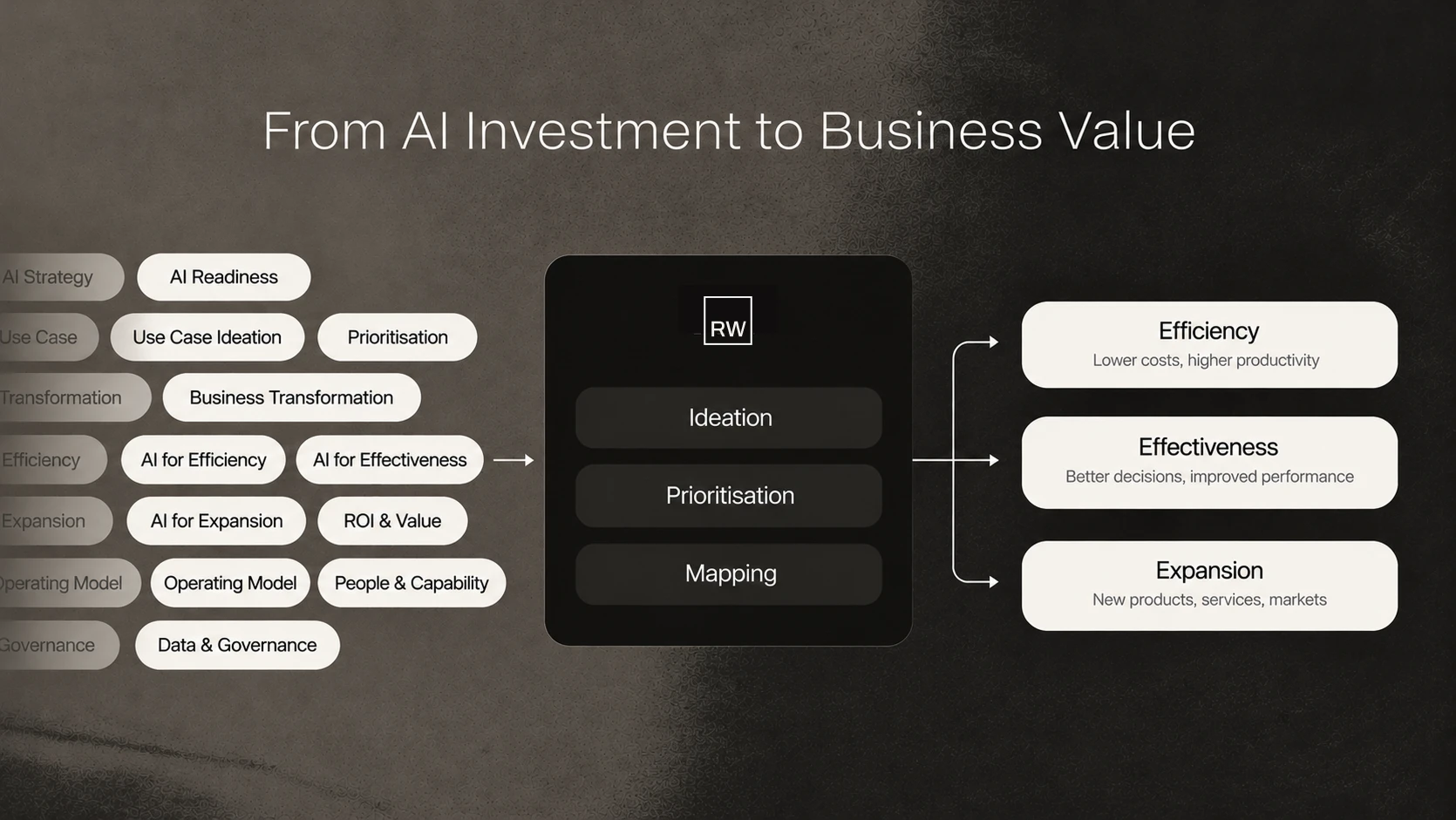

Staff are ahead. Strategy is behind.
Employees are putting AI to work faster than organisations are setting the direction. The next challenge is turning individual initiative into coordinated business progress.
Employees are not waiting for their organisations to finish developing an AI strategy. They’re experimenting with tools, finding new ways to complete tasks and incorporating AI into everyday work. In many businesses, the technology is becoming familiar long before its role in the organisation has been clearly defined.
The evidence suggests this is becoming a widespread leadership challenge.
BCG’s 2026 AI at Work study found that 74% of frontline employees surveyed globally were using AI daily or several times a week. Yet only around a third considered their leadership’s communication about AI to be clear.
Similarly, Microsoft’s 2026 Work Trend Index, which surveyed 20,000 AI users across ten countries, found that only 26% believed their leadership was clearly and consistently aligned on AI. The UAE was not included in that sample.
These findings come from different populations, but they point towards a common challenge: employees can become capable users of AI without understanding how their individual efforts contribute to a wider organisational strategy.
The problem isn’t necessarily a lack of enthusiasm for AI. It’s a lack of shared direction for what that enthusiasm should achieve.
The UAE has the momentum to lead. Leadership can make it count.
The GCC has established a strong foundation for AI adoption in the workplace.
In BCG’s 2025 survey of more than 1,000 employees across four GCC countries, 87% reported using AI at least several times a week, compared with 72% globally in the same study.
The research also found encouraging levels of institutional support. Among frontline employees surveyed in the GCC, 55% reported receiving clear leadership guidance and support for AI.
The region is not starting from a position of widespread resistance or unfamiliarity. Employees are already developing practical experience, and many organisations are actively encouraging them.
Dubai’s government offers a particularly compelling example of how that ambition can be translated into action.
In April 2024, Sheikh Hamdan bin Mohammed launched the Dubai Universal Blueprint for Artificial Intelligence. The blueprint went beyond setting an ambition. It outlined practical measures to accelerate AI adoption through dedicated leadership, support for AI businesses, workforce development and enabling infrastructure.
Just six weeks later, Dubai appointed 22 Chief AI Officers across government entities, assigning responsibility for advancing specialised AI plans and programmes.
“What’s interesting about Dubai’s approach is that it didn’t stop at saying AI was important. It put people in charge of making something happen. That’s the difference between having an ambition and giving an organisation a direction it can actually follow.”
AI strategy is becoming a competitive necessity.
Dubai’s approach sends a clear signal to businesses operating in the UAE. AI is not being treated as a passing technological trend, but as an important part of the country’s economic future.
As AI becomes embedded in business operations, it has the potential to change what customers expect, how quickly companies respond, what services cost to deliver and how organisations compete.
For business leaders, the question is no longer simply whether AI could improve their operations. It’s how quickly those improvements might become standard expectations across their industry.
A business doesn’t need to adopt every emerging AI tool. But it does need to understand where the technology could change its competitive position, what capabilities it should develop and where investment will create meaningful value.
Whether to adopt a particular AI technology remains a choice. Whether to respond to a market being reshaped by AI increasingly does not.
When direction is unclear, employees make their own rules.
Employee initiative is valuable. But when individuals adopt AI without a shared organisational direction, their efforts can become fragmented.
Different departments select different tools. Employees develop their own methods for handling information, assessing outputs and deciding which tasks to automate. Useful practices remain isolated, while risks and inconsistent standards can spread across the organisation.
BCG’s 2025 GCC research illustrates the strength of that independent initiative: 63% of respondents said they would use AI tools even without company authorisation.
That figure reflects stated willingness rather than confirmed unauthorised use. Nevertheless, it highlights an important leadership consideration. Employees see enough value in AI that some are prepared to use it regardless of whether their organisation has established clear boundaries.
Consider a diversified family business where employees across sales, finance and operations have independently introduced AI into their work.
Sales teams use it to prepare commercial proposals. Finance teams generate summaries and analyse documents. Operations staff automate reporting and administrative tasks.
Each department may achieve genuine improvements. Yet the business has no consistent approach to selecting tools, protecting sensitive information, checking outputs or deciding which successful practices should be adopted more widely.
What begins as a collection of useful individual improvements can remain exactly that: a collection of disconnected activities.
“Employees are already experimenting with AI. Telling them to be more innovative isn’t a strategy. The hard part is deciding which of those experiments should become a better way of working — and giving people the support to make that change.”
The answer is not to discourage experimentation or insist that every useful idea must originate with senior leadership.
It is to establish enough direction that individual initiative can contribute to a common organisational purpose.
A strategy matters when it changes how work gets done.
An AI strategy should provide more than a statement of technological ambition.
It should explain what the organisation is trying to improve, where AI can contribute, which changes deserve investment and how people are expected to work differently as a result.
This distinction matters because a strategy that exists only at leadership level does little to guide the employees making decisions about AI every day.
BCG’s 2026 global research found that clear AI strategy was associated with a substantially greater improvement in reported business impact than better access to tools alone. Its analysis identified a 25-percentage-point difference associated with strategic clarity, compared with approximately five points for better tools.
The findings reinforce an important principle: technology access is only one part of organisational change. The surrounding direction, working practices and management decisions matter considerably.
Return to the family business.
A useful strategy might identify customer response times and proposal quality as priorities for the sales function. Leadership could then establish where AI should support those activities, what information employees may use, which outputs require human review and how improvements will be assessed.
The finance and operations teams may have different priorities, but their initiatives would follow the same organisational principles.
Employees still have room to experiment. The difference is that experimentation now has a purpose, boundaries and a route towards wider adoption.
Strategy gives individual capability a direction. Organisational change turns that direction into results.
Managers turn strategic ambition into everyday practice.
Senior leadership can establish the direction, but managers play a critical role in making it real.
They determine how priorities are translated into everyday activities, how employees are supported and whether new ways of working are encouraged or quietly displaced by existing routines.
Research suggests their influence is substantial.
According to Gallup’s 2026 research on workplace AI in the United States, employees in organisations adopting AI who strongly agreed that their manager actively supported AI use were 1.7 times as likely to use it frequently.
Support, however, means more than encouraging employees to try new tools.
Managers need to understand the organisation’s priorities, recognise where AI is appropriate, establish expectations for quality and provide employees with the time and confidence to change established processes.
They also need clarity about their own responsibilities.
If leadership expects employees to redesign workflows while managers remain accountable only for existing processes and short-term targets, the organisation creates competing incentives.
Microsoft’s 2026 research identified a similar tension: many AI users wanted to adapt quickly, but only a small proportion felt rewarded for reinventing work.
Managers cannot resolve that contradiction without visible support from leadership.
“A strategy shouldn’t require a slide deck to explain. If a manager can’t tell their team what they should do differently tomorrow, it isn’t yet doing its job.”
This is where leadership alignment becomes tangible. Not in the number of strategy presentations delivered, but in whether managers understand the direction, reinforce it consistently and help employees act on it.
Give people a direction they can act on.
For organisations already experiencing widespread AI adoption, the immediate priority may not be another broad campaign encouraging employees to use the technology.
It may be to make the existing ambition more specific.
Leadership should be able to explain where AI is expected to improve the organisation, which activities are priorities and what successful implementation would look like.
Employees need to understand which tools and practices are appropriate, what information they can use and where human judgement and accountability remain essential.
Managers need the authority, support and practical understanding to translate those expectations into their teams’ work.
And the organisation needs a way to distinguish useful experimentation from improvements worth developing into repeatable, established practices.
A useful test is whether employees across different functions can answer the same basic questions: What are we trying to improve? Where should AI help? What are the boundaries? And how will we know the change is working?
If the answers differ significantly across teams, the organisation may have an AI ambition without a shared operational direction.
The objective is not to control every experiment. It is to create the conditions in which promising ideas can be developed responsibly, adopted consistently and connected to meaningful business outcomes.
The next advantage belongs to organisations that move together.
The UAE and wider GCC have demonstrated considerable enthusiasm for AI, supported by employees willing to experiment and institutions investing in technological progress.
That momentum is valuable. But its long-term significance will depend on whether organisations can bring leadership, management and employees into closer alignment.
Individual initiative can reveal opportunities. Leadership must establish which opportunities matter, create the conditions to pursue them and ensure that changes extend beyond isolated pockets of activity.
Employees have already shown their willingness to move with AI. The next advantage will belong to organisations whose leadership gives that movement a clear direction.
Sources: BCG, AI at Work (2026). Microsoft, Work Trend Index (2026). BCG, AI at Work in the GCC (2025). Dubai Media Office, Dubai Universal Blueprint for Artificial Intelligence (2024). Dubai Government, appointment of 22 Chief AI Officers (2024). BCG press release, 3 June 2026. Gallup, Artificial Intelligence in the Workplace (2026).