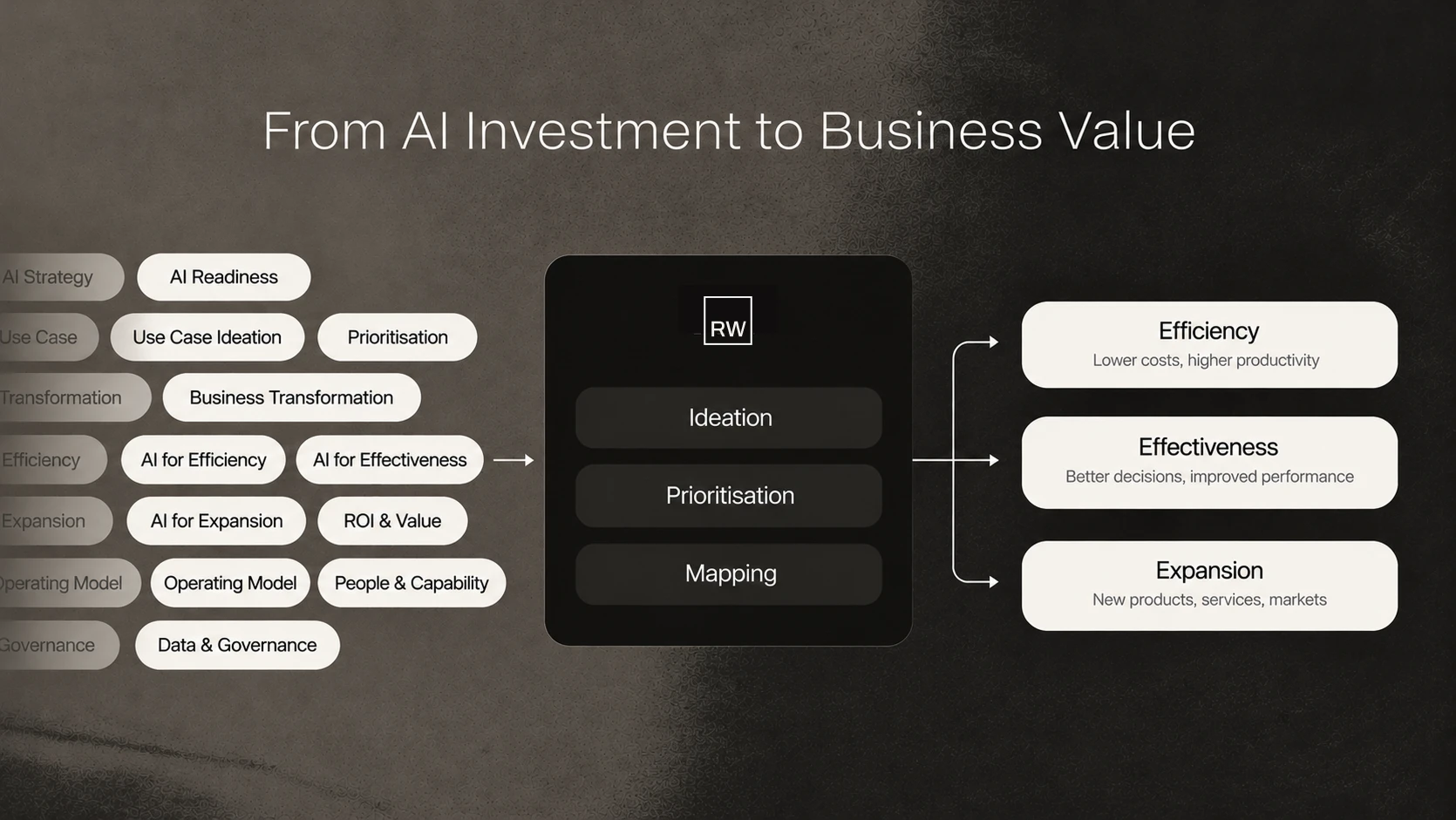

AI adoption is widespread. Where is the value?
The UAE leads the world in AI adoption. The next opportunity is turning that lead into measurable business value.
The UAE has become one of the world’s most enthusiastic adopters of artificial intelligence. Businesses are experimenting with new tools, employees are incorporating AI into everyday work, and government entities are pursuing ambitious programmes to transform public services.
According to Microsoft’s September 2026 Global AI Diffusion Report, 73.3% of the UAE’s working-age population was using AI in the second quarter of 2026, the highest proportion reported worldwide.
It is a remarkable achievement. But adoption raises a second, more commercially important question: what value is it creating?
Globally, McKinsey’s 2026 State of AI report found that nearly nine in ten respondents reported regular AI use in at least one business function. Eighty percent reported improvements in their individual productivity, yet only 37% attributed any positive impact on enterprise EBIT to AI.
These are different measures, drawn from different populations. They should not be treated as a direct comparison of the UAE’s financial returns. Nevertheless, they illustrate a broader challenge facing organisations everywhere.
Using AI and creating measurable value from AI are not the same achievement.
The UAE has the conditions to lead in value creation.
The UAE’s early adoption has created an important foundation. A workforce familiar with AI, leadership willing to invest and a government committed to technological development all provide the conditions for meaningful progress.
The wider region is also developing the capabilities needed to support that ambition.
In a 2026 study of approximately 200 GCC organisations, BCG classified 39% as AI Leaders, based on an assessment of their ability to deploy and scale AI capabilities.
“I don’t think the UAE needs convincing that AI matters. There’s already enormous enthusiasm for the technology. What interests me now is whether businesses and government entities can take that momentum and turn it into something tangible. Better services, stronger businesses, more capable people. The next competitive advantage won’t come from how quickly organisations adopt AI, but from how effectively they turn that adoption into value.”
The findings reflect growing organisational maturity across the region and the potential to translate AI capabilities into stronger business performance.
At a national level, Abu Dhabi’s Government Digital Strategy 2025–2027, supported by AED 13 billion in planned investment, includes more than 200 AI solutions and an anticipated contribution of over AED 24 billion to GDP by 2027.
These developments illustrate the scale of the opportunity. The UAE has established many of the conditions necessary for AI to become a meaningful source of competitive advantage, from workforce familiarity and organisational capability to sustained institutional investment.
The opportunity now is to convert that foundation into measurable improvements in how businesses and institutions perform.
Organisations struggle to define, measure and distinguish value from activity.
Most organisations can measure AI adoption relatively easily. They know how many licences have been purchased, which applications employees use and how frequently those tools are accessed.
These are useful indicators of engagement. They provide very little evidence of commercial value on their own.
Part of the problem is that value looks different across organisations. For businesses, it may be reflected in profitability, service quality, decision-making or operational performance. For government entities, it may emerge through faster services, fewer errors, better resource allocation and improved citizen experiences.
Not every benefit will appear immediately on a profit and loss statement. But organisations should still be able to explain what has improved and provide credible evidence.
Consider a business that introduces AI across its sales operations. Employees use the technology to research prospects, prepare quotations and draft client communications. Adoption is high, and the response from staff is positive.
Yet leadership cannot establish whether quotations are being processed faster, whether conversion rates have improved or whether the cost of supporting sales has changed.
The technology may be useful, but the business has not yet demonstrated what that usefulness is worth.
Three distinct measures help clarify the difference:
An organisation can perform well against the first measure while making little progress against the other two.
This does not mean adoption is unimportant. Familiarity and practical experience are often prerequisites for developing more valuable capabilities.
But adoption should be understood as a starting point, not the final measure of success.
Value requires deliberate changes to how work is performed.
A common mistake is to assume that the financial benefits of AI will emerge naturally as employees become more proficient with the technology.
Individual productivity improvements are valuable, but the organisation must still determine how to convert them into meaningful outcomes.
That usually requires examining the work itself.
Return to the sales operation. Rather than measuring how frequently employees use AI, leadership could examine the entire quotation process, from receiving a customer enquiry to preparing, reviewing and delivering a proposal.
Where does the process slow down? Which activities create unnecessary costs? Where do errors occur? What information could improve the quality of a commercial decision?
AI might help accelerate the preparation of quotations, but the greater opportunity could involve redesigning how information is collected, approvals are managed and proposals reach customers.
“We’ve become very good at measuring how many people are using AI, but that tells us remarkably little about the value it’s creating. The real work begins when you ask what needs to change inside the business, how you’re going to change it, and what evidence would convince you that it’s worked.”
The organisation can then compare performance against an established baseline and determine whether the change has produced a worthwhile result.
This is why a focused approach to AI investment can be more valuable than a large collection of disconnected initiatives.
An organisation does not need to transform every process simultaneously. It needs to identify commercially meaningful opportunities, understand the economics and establish whether the expected improvements can be realised.
Start with one workflow, a measurable outcome and clear accountability.
For many organisations, the first step towards demonstrating AI value is relatively straightforward.
Identify one workflow that materially affects cost, revenue, service quality or risk. Establish how it performs today, determine what improvement would be worthwhile and make someone accountable for achieving it.
That creates three essential conditions.
- A baseline. A credible understanding of current performance against which improvements can be measured.
- An owner. Someone with responsibility for the workflow and the authority to act on what the evidence reveals.
- A decision point. An agreed moment to assess whether the initiative should continue, change direction or stop.
These principles apply whether the organisation is implementing a relatively simple administrative automation or investing in a more sophisticated operational capability.
They also encourage a necessary change in management behaviour. Instead of asking departments to report how many employees are using AI, leadership begins asking what changed, who is responsible and whether the result justifies further investment.
The financial principles underlying these decisions are explored in The rules of AI ROI, including how organisations should evaluate different types of returns and allocate capital accordingly.
The UAE’s next advantage will come from demonstrable results.
The UAE has already demonstrated how quickly AI can become part of everyday business and government operations. That foundation is valuable, but its lasting significance will depend on what organisations do with it.
For business leaders and government decision-makers, the challenge is no longer simply encouraging adoption. It is identifying where AI can make a meaningful difference, changing how work is performed and establishing whether those changes deliver the results expected.
The UAE has shown how quickly a country can adopt AI. Its next advantage will be built by the organisations that can demonstrate what that adoption is worth.
Explore AI Business ValueSources: Microsoft, Global AI Diffusion Report (September 2026). McKinsey & Company, The State of AI (2026). BCG, Unlocking Potential: How GCC Organizations Can Convert AI Momentum into Value at Scale (2026). Abu Dhabi Media Office, Abu Dhabi Government Digital Strategy 2025–2027.